SEO Best Practices for Businesses: Lessons from St. Thomas Hotels
By: Michael Emanuel
Date: May 30, 2026
An image of Search Engine Optimization (SEO)
Search Engine Optimization (SEO) is one of those terms that you hear a lot when you have (or are looking to have) a website. But why is SEO so important and why should you care? SEO is the process of optimizing your website so that it ranks higher in search results – thereby increasing your website’s organic (unpaid) traffic. In the Virgin Islands, this is not an often-explored topic because many businesses rely on word-of-mouth to get traction. However, that only takes you so far – especially when you’re in a highly competitive field.
To be clear, SEO is a long game; it takes a while to get the level of organic website traffic needed to generate significant business revenue. However, once it is established, it becomes a powerfully stable income source. So how do you do SEO the right way for your business? This article will explore SEO best practices by examining an industry that heavily relies on organic website traffic – hotels.
If you want a free SEO audit of your website, fill out the form here.
Methodology
This article uses data that was collected and analyzed from six hotels located in St. Thomas, though I will not be identifying them in this discussion. The identities of these businesses are not relevant to this analysis, but rather how they implement their SEO strategies.
These are the two categories and corresponding metrics that I used in this analysis:
Google Profile Positioning
Reviews
Profile Description
Amenities
Photos
Name, Address, Phone (NAP) Consistency
Search Result Positioning
On-Page SEO
Off-Page SEO
Technical SEO
Social Media SEO
Website performance (LCP, INP, FCP, TTFB, and CLS) *see Glossary for these terms
To determine which hotels I examined, I used the keyword “hotels St. Thomas”, as it has the highest search volume for hotels in St. Thomas (see glossary for keyword definition).
I examined the top three results that I received for each of these categories at the time I conducted this analysis. Hotels A, B, and C will be used to discuss Google Profile positioning and Hotels D, E, and F will be used for Search Result Positioning.
Note that Google Profile and Search Result Positioning can be biased depending on your physical proximity to the results shown, advertisements, and other factors. In this case, I did receive results that were quite far from my physical location, and I avoided all sponsored results, so that increases my confidence in this analysis.
SEO Glossary
I will forewarn you that this article has a lot of technical jargon that you may not understand. As such, here is a glossary of terms that you can refer to as a guide:
Largest Contentful Paint (LCP) – Measures how long it takes to load the largest visible element on your website (e.g., picture, video, etc.). A passing score is 2.5 seconds
Interaction to Next Paint (INP) – Measures how long a website takes to respond visually to a user’s action (e.g., clicking buttons, typing text, or tapping a menu). A passing score is 200 milliseconds (or 0.2 seconds).
First Contentful Paint (FCP) – Measures how long it takes for a webpage to load its first piece of content (e.g., a banner or a hero section). A passing score is 1.8 seconds
Time to First Byte (TTFB) – Measures how long it takes for a web browser to render the first visual element after a user navigates to it (e.g., how long it takes for something to load when you scroll down to it). A passing score is 800 milliseconds (or 0.8 seconds)
Cumulative Layout Shift (CLS) – Measures the visual stability of page content (e.g., sudden text shifts). A passing score is 0.1
On-page SEO – Optimizing individual web pages (e.g., content, coding, and structure) to rank higher in search results and gain relevant organic traffic.
Off-page SEO – Actions outside of your website to improve search rankings and authority (e.g., backlinks, social signals, and brand mentions).
Technical SEO – Optimizing backend infrastructure such as sitemaps, security, mobile friendliness, and structured data.
Social media SEO – Optimizing social profiles and content to rank higher on social platforms (e.g., Facebook, LinkedIn, and Instagram). These profiles should be linked to your website.
Domain Authority – A score-based prediction of the likelihood of a website to rank in search results. The higher the score, the better (max is 100).
Search traffic – The number of people that visit a website in any given period of time. Organic search traffic measures the number of people that visit a website in any way that doesn’t involve a paid ad.
Referring Domains – Any external website that contains links to another website (e.g., a booking agency like Expedia would be a referring domain for the hotels listed in this article).
Backlink – A clickable link from one website to another that act as votes of confidence to search engines. Backlinks from high quality websites result in a stronger vote of confidence.
Keyword – A word or phrase that is typed into a search engine to find information, products, and services.
Google Profile Analysis
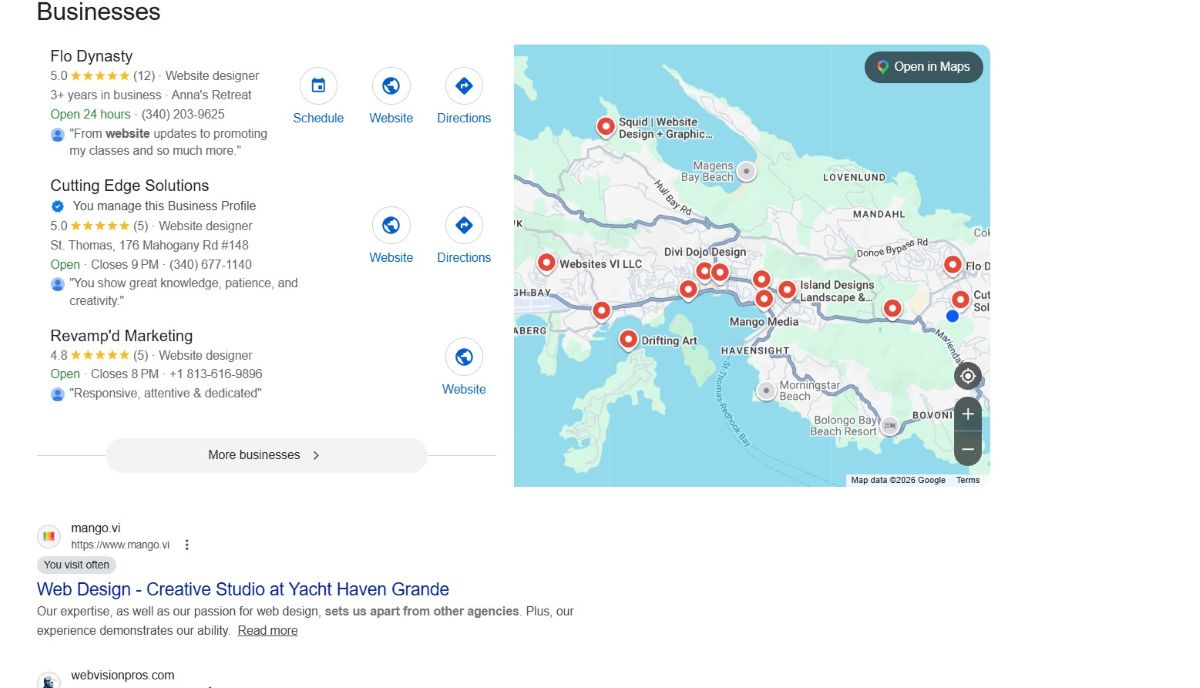
The first category we will examine is Google Profile Positioning. Google Profiles are quick snippets of your business that appear in localized search results. Profiles typically show up before other search results. Here’s an example:
A screenshot depicting the top St. Thomas web design Google Profiles
This analysis focused on which hotels showed up first in localized results. Here’s how each metric factors into the strength of a hotel’s Google profile:
Reviews – The number of reviews, ratings, and (most notably) the responses to reviews from the business are strong ranking factors for a Google profile.
Profile Description – Profiles that are fully completed are a signal to Google that your business is trustworthy. Leaving any information out gives your competitors an edge
Amenities – The number of amenities, especially popular ones, will help Google determine how relevant a hotel is in search results. Also, being accurate about the amenities offered helps you avoid negative reviews – which hurts your ranking.
Photos – Engaging visual content that shows nearby attractions, amenities, physical location, and the rooms offered are prioritized by Google
Name, Address, Phone (NAP) Consistency – Google prioritizes profiles that have consistent NAP information across multiple platforms (e.g., Google, social media, website, etc.
Here is the analysis of each hotel’s profile. You can skip to the next section to get the summary if you don’t want to read this.
Hotel A
Reviews - Most reviews on Google (2.6k) – and highest rating. Lower reviews on other travel sites but is cited in more travel sites than the others. Responds to most or all reviews.
Profile Description - Profile includes a short description and lists the amenities of the hotel. Lots of nearby attractions referenced (25)
Amenities - 21 amenities – including game room, pet & child friendly, hot tubs, and laundry.
Photos - Strongest photo profile of the three (2,792)
Name, Address, and Phone Consistency - The website linking to this hotel is a third-party booking site with different contact information. However, the NAP information for the hotel is on the website.
Hotel B
Reviews: Slightly weaker rating (3.9) and lower review count than the other two (769). Note: much more reviews than other two on other travel sites. Responds to most or all reviews.
Profile Description - Doesn’t describe the hotel in the profile section. However, this hotel references more amenities than any of the other hotels. Also, referenced more nearby attractions than the others (26)
Amenities - 43 amenities, including a full gym, concierge services, valet parking, and public workstation. No breakfast included.
Photos - Weakest photo profile. 813 pictures
Name, Address, Phone (NAP) Consistency - NAP is consistent in the Google Profile and the linked website.
Hotel C
Reviews - Second highest reviews on Google (2.2k) and equally high ranking to Hotel A. More reviews on other sites than Hotel A. No responses to reviews – weakens ranking
Profile Description - Profile description is the longest of the three and references all amenities. Referenced the least amount of nearby attractions (16)
Amenities - 18 amenities, including fitness center, hot tub, laundry, and food options. No spa or pets.
Photos - Second strongest photo profile. 987 pictures
Name, Address, Phone (NAP) Consistency - NAP is consistent in the Google Profile and the linked website.
Discussion
Here’s the TLDR in case you didn’t want to read all of that:
Hotel A has the strongest reviews portfolio and photo gallery on their Google profile in this group. It also listed a competitively strong number of nearby attractions and had consistent NAP information as well.
Hotel B, by far, had the strongest amenities listing of the three, consistent NAP information, and listed the most nearby attractions. However, the profile description was missing some information, the photo gallery is the smallest of the group, and the review count and rating are slightly lower than the other two hotels.
Hotel C enjoys a comparable number of reviews to hotel A, the second strongest photo portfolio, and has the longest profile description. However, the responses to reviews were inconsistent, the amenities listing is the smallest of the group, and it had the least number of nearby attractions.
Best Practices
While some of these results are specific to hotels, there are general takeaways that you can learn from this:
Ensure your Google profile is fully completed. Fill out all service information, hours of operation, locations served, social profiles, and anything else that is requested.
Always ask for reviews (and always respond to them).
Include pictures of your work on your profile. They show up in search results and can be helpful to people searching for your products or services.
Ensure NAP consistency. Anything that is linked to your Google profile needs to have the same business name, address, and phone number so that Google doesn’t get confused.
SEO Analysis
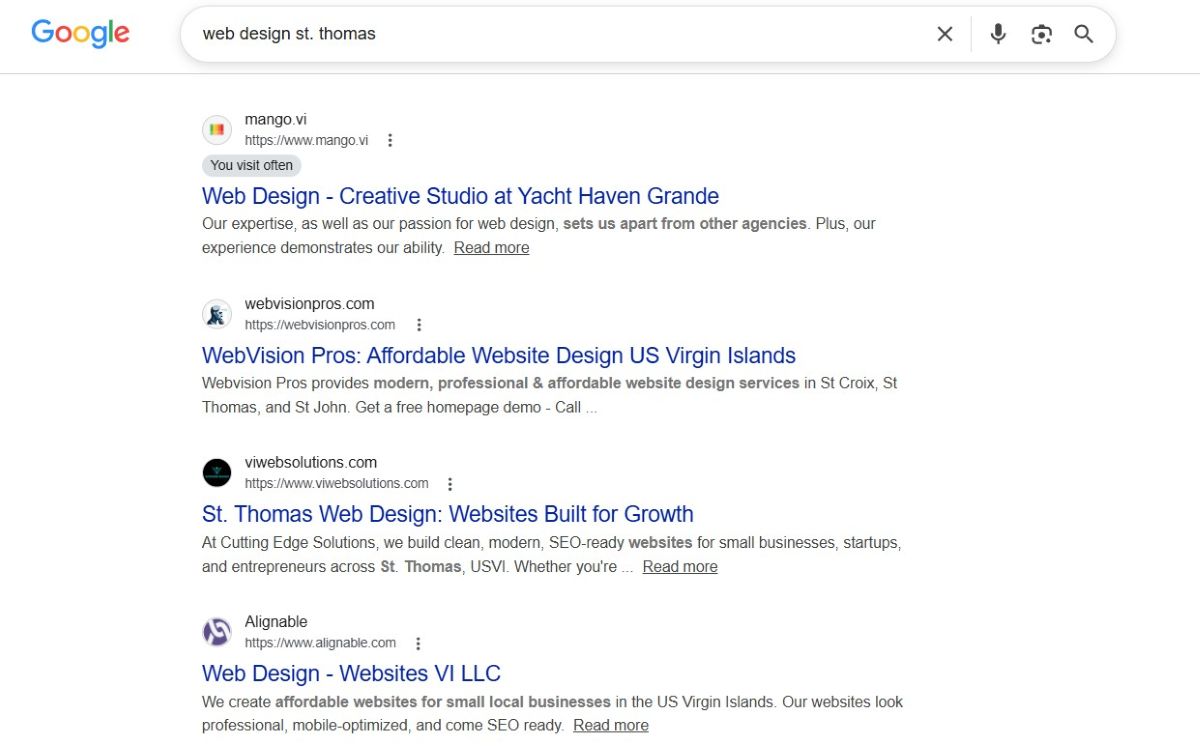
To recap, I used the top search results using the keyword mentioned previously to determine which hotels to examine. To give an example, look at the screenshot below:
A screenshot depicting the top search results for web design St. Thomas
You’ll notice that Mango Media, WebVision Pros, and Cutting Edge Solutions (www.viwebsolutions.com) are the top three websites that show up in search results when you type in the keyword, “web design St. Thomas”. I utilized this methodology to determine the top hotels to examine.
The hotels were examined based on the following metrics (refer to the glossary for a recap on these terms):
On page SEO
Off page SEO
Technical SEO
Social Media SEO
Website Performance
Here is the SEO analysis of each hotel. You can skip to the next section to get the summary if you don’t want to read this.
Hotel D
On-page SEO - On-page SEO needs improvement due to poor content structure (no H1 or H2 tags), long meta description, and missing alt text.
Off-page SEO - Compared to competitor averages, the domain authority (44 vs. 10), backlink profile (448 vs. 45), and referring domains (174 vs. 28) are all strong. However, the backlink profile isn’t balanced, which may hurt overall SEO ranking
Technical SEO - The website lacks a sitemap, robots.txt file, and has erroneous structured data. However canonical tags and indexing are working properly.
Social Media SEO - The website contains links to a few social media profiles, though it could include some more.
Website Performance (Mobile) -
LCP - 4.9s (Fail)
INP - 105ms (Pass)
CLS - 0.17 (Poor)
FCP - 4.6s (Fail)
TTFB - 3.4s (Fail)
Website Performance (Desktop) -
LCP - 3.2s (Poor)
INP - 47ms (Pass)
CLS - 0.09 (Pass)
FCP - 2.6s (Poor)
TTFB - 2.3s (Fail)
Hotel E
On-page SEO - On-page SEO is decently strong, with good content structure (header tags), text to code ratios, keyword density. The only minor concerns are missing alt-text for some images and a slightly long meta description.
Off-page SEO - Could make some improvements in this area. Backlink profile is much smaller than industry average, but the profile is balanced overall (i.e., not spammy). Domain authority score is lower than the competitor average (50 vs. 58). The number of referring domains is higher than average, which is good.
Technical SEO - The website is highly optimized from a technical standpoint. Structured data, sitemaps, robots.txt files, canonical tags, etc. are all properly established.
Social Media SEO - Virtually no social media presence is linked to their website. This hurts overall SEO ranking.
Website Performance (Mobile)
LCP - 4s (Poor)
INP - 254ms (Poor)
CLS - 0.09 (Pass)
FCP - 2.5s (Poor)
TTFB - 1.7s (Poor)
Website Performance (Desktop)
LCP - 3.6s (Poor)
INP - 140ms (Pass)
CLS - 0.22 (Poor)
FCP - 2.1s (Poor)
TTFB - 1.5s (Poor)
Hotel F
On-page SEO - On-page SEO is very strong, with only the minor concern of a long meta description
Off-page SEO - Domain authority is slightly lower than the competitor averages (43 vs. 45). Backlink profile (1,373 vs. 45) and referring domains (299 vs. 47) are both strong, however the backlink profile isn’t balanced which may hurt ranking.
Technical SEO - The website is highly optimized from a technical standpoint, however the structured data and robots.txt files need correction.
Social Media SEO - The website contains links to a few social media profiles, though it could include some more.
Website Performance (Mobile)
LCP - 1.7s (Pass)
INP - 109ms (Pass)
CLS - 0 (Pass)
FCP - 1.5s (Pass)
TTFB - 0.8s (Pass)
Website Performance (Desktop)
LCP - 1.3s (Pass)
INP - 62ms (Pass)
CLS - 0 (Pass)
FCP - 1.1 (Pass)
TTFB - 0.5s (Pass)
Discussion
There’s a lot of information presented here, so I will focus on the main points:
Hotel D – Their website has many external votes of confidence (backlinks and referring domains), decent social media profiles, and technical optimization. However, the website content isn’t well structured (from Google’s standpoint), the sitemap appears to be missing, and the overall website performance is lackluster per Google’s performance metrics (i.e., loads too slowly and does not respond quickly enough to user actions).
Hotel E – This website has great content structure, technical optimization, and decent domain authority. However, its backlink profile is a bit weak and there is no social media presence that is linked to the website. Also, the overall website performance needs some work.
Hotel F – This website boasts strong content structure, technical optimization, domain authority, and backlink profile. Also, the overall website performance is the best of the three – passing all of Google’s metrics. However, the website needs a more balanced backlink profile and corrections to its structured data.
Critiques notwithstanding, all these hotels enjoy a combined average of almost 13,000 website visitors per month. So, while they may not employ perfect SEO practices, they do not lack presence.
Best Practices
As before, there are several lessons that we can take away from this analysis:
Conduct Keyword Research before you create content. This is implied in this discussion, however ensuring that your website ranks highly for common keywords in your industry is vital to being discovered organically.
On page SEO
Ensure that your website content is properly structured. This means that your headers are appropriately assigned (H1 Header, H2 Sub header, etc.) based on the presentation of your content
Create appropriate SEO titles and meta descriptions. Don’t make them too long or stuff them full of keywords, but ensure that they contain the information that your clientele is looking for. Refer to the second screenshot above as a guide.
Off page SEO
Build a strong backlink profile. This is not the easiest thing to do, but it pays dividends over time. Create high quality content that other organizations, businesses, or newspapers, would want to reference on their platforms and connect with them to make that happen. Note: it’s better to have a few high-quality backlinks than a lot of low-quality ones.
Technical SEO
Make sure all technical aspects of your website are optimized. You might need to hire someone for some parts of this since it can get very complicated. But the things to watch for are your robots.txt files, sitemap, structured data (if you have any – you should), and canonical tags.
Social Media SEO
Build your social media profiles and link them to your website. This isn’t a difficult thing to do, but it’s vitally important since most of your external website content will go on social media. This ties into off page SEO, but the more high-quality content you can push on social media that is also linked to your website, the stronger your SEO will be.
Website Performance
Make your website as nimble as possible. Reduce website bloat by compressing image files (aim for 50kb or less), reduce overall page size (aim for under 500kb), minimize the number of processes that need to be loaded on the page, and keep your content visually stable. This will vastly improve your website performance and SEO.
Conclusion
If you made it this far, thank you. This was a long article, but one that I think highlights the importance of SEO and what we can learn from some of the strongest examples in St. Thomas. Recall how I mentioned that hotels D, E, and F receive almost 13,000 website visitors per month on average. I imagine most businesses here don’t receive even 10% of that in any given month. With numbers like that, you can appreciate how these businesses are as successful as they are. Learning from their example can help other businesses enjoy similar success in the future.
If you would like me to do a similar SEO audit of your existing website, fill out this form and get one for free!


.png)